
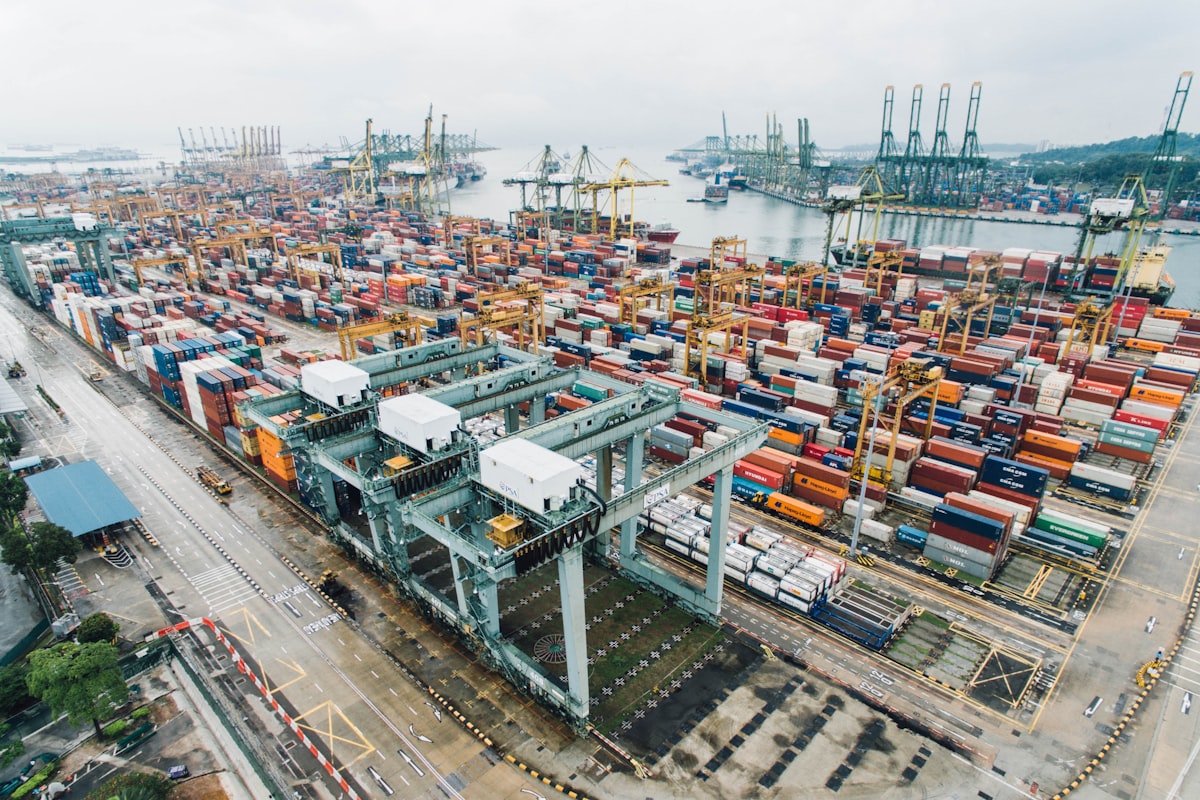
Custom software development for logistics pays off in the gaps between the systems you already rent: the customer who calls three times a day asking where the load is, the dispatcher retyping orders from email into the TMS, the proof-of-delivery photos that live in a driver's phone. Small carriers, brokers and 3PLs should keep buying their core TMS, accounting and telematics. They should build the thin layer that connects those systems and faces their customers.
That layer is where your service feels different from the carrier next door. It is also where off-the-shelf software is weakest, because every shipper wants updates, documents and quotes in a slightly different way.
Key Takeaways
- Keep the core systems standard: TMS or WMS, accounting, telematics and ELD.
- Build custom where you touch customers and where staff retype data: tracking portals, order intake, quoting, document capture.
- The value of a custom tool in logistics usually comes from integrations, so check which of your systems offer an API before you scope anything.
- Estimate it in hours against a written scope, then get a fixed price paid in milestones tied to working features.
What Logistics Companies Build Custom vs Buy
| Area | Buy | Build custom | Why |
|---|---|---|---|
| Transportation or warehouse management | Yes | Rarely | Mature products, core workflows are shared |
| Accounting and invoicing | Yes | No | Solved problem |
| Telematics and ELD | Yes | No | Hardware, regulation and data feeds |
| Customer tracking portal | Sometimes | Often | Your customers, your branding, your status rules |
| Order intake from email, PDFs and spreadsheets | Weak | Often | Every shipper sends orders differently |
| Spot quoting with your own rules | Generic | Often | Your lanes and margins are your edge |
| Proof of delivery and document capture | Sometimes | Often | Ties photos and signatures to the right load |
| Reports across several systems | Limited | Often | Data lives in three places |
The rule: if every logistics company does it the same way, rent it. If your customers pick you because of how you do it, consider building it.
Integrations Are the Real Project
A tracking portal is easy to draw. The work is pulling load status from your TMS, positions from your telematics provider and documents from wherever drivers upload them, then keeping all three in sync.
Most modern platforms expose an API for this. Postman's 2025 State of the API report, a vendor survey of more than 5,700 developers and leaders, found 82% of organizations have adopted some level of an API-first approach. In practice that means your newer systems probably have an API, and your oldest one probably does not. Before you scope anything, list each system, ask the vendor whether it has an API and what it costs to use, and note anything that only exports a CSV. That list decides half the budget. Our post on API integration services goes into how to buy that work.

What Custom Software Development for Logistics Costs
There is no trustworthy published price list for logistics tools, so build the estimate from hours. A customer tracking portal with logins, load status and documents is often 150 to 250 hours. Each integration adds roughly 30 to 80 hours depending on how good the vendor's API is.
For a rate anchor, Clutch's pricing page (updated September 21, 2026) puts US software firms at $50 to $99 an hour and Mexico-based firms at $25 to $49. Those numbers come from reviews on Clutch's own platform, so treat them as a rough range. Then add upkeep: integrations break when a vendor changes its API, so budget a few hours a month. We cover realistic numbers in app maintenance cost per year.
A Concrete Version
A 25-truck regional carrier gets about 60 "where is my load" calls a day. Each takes a dispatcher about 4 minutes, so 240 minutes, or 4 hours a day, goes to answering the phone instead of planning loads.
The carrier builds a customer tracking portal plus automatic text updates at pickup, in transit and delivery: 200 hours for the portal and 60 hours to integrate with the TMS, so 260 hours. At an assumed $50 an hour (an assumption for this example, not a quote), that is $13,000.
Three months in, status calls drop by about 70%. That frees 2.8 dispatcher hours a day. Over 250 working days, that is 700 hours. At the $28 an hour the owner uses as a dispatcher's loaded cost, the saving is $19,600 a year, so the build pays back in about eight months. The less visible win: two shippers mention the portal when they renew.
The Honest Counterpoint
Custom software development for logistics is the wrong call in some common cases.
If your TMS vendor already sells a customer portal that covers 80% of what you need, buy it, even if it is a bit ugly. A custom portal you have to maintain is a real cost. If your core data is a mess, with loads in a spreadsheet and statuses updated whenever someone remembers, a portal will just show customers the mess faster. Fix the process first. And if you are a startup building logistics software as your product, you are not buying a tool, you are building a company, which is a hiring question we cover in hiring engineers for a logistics startup.
Frequently Asked Questions
What does custom software development for logistics companies usually include?
Most small carriers, brokers and 3PLs build customer tracking portals, order intake from email and documents, spot quoting tools, proof-of-delivery capture and reports that combine data from several systems. The TMS, accounting and telematics stay off the shelf.
How much does custom logistics software cost?
A tracking portal is often 150 to 250 hours, and each integration adds 30 to 80 hours depending on the vendor's API. Multiply by the rate you are quoted, and insist on a fixed price against a written scope.
Should a small 3PL build its own WMS?
Usually no. Warehouse management is a mature, shared problem. Build the customer-facing and integration pieces around a standard WMS instead, unless your warehouse process is truly unlike anyone else's.
The Bottom Line
Rent the core, build the layer your customers see, and scope around the integrations. Before you call a developer, describe the problem to Sol in a free Honest Read. You get a verdict, the hard parts, what to leave out of version one and real cost ranges for each path, as a PDF any developer can quote from. Here is what the Honest Read covers. For a quick ballpark, try the project calculator, and if you want it built, our software factory works at a fixed price and you own the code. If you are still deciding between buying and building, custom software vs off-the-shelf for small business lays out the tradeoffs.
Roberto Espinoza is CEO of Ruzora, which helps US startups hire pre-vetted senior LATAM engineers, with a vetted shortlist in 72 hours. See available engineers.


